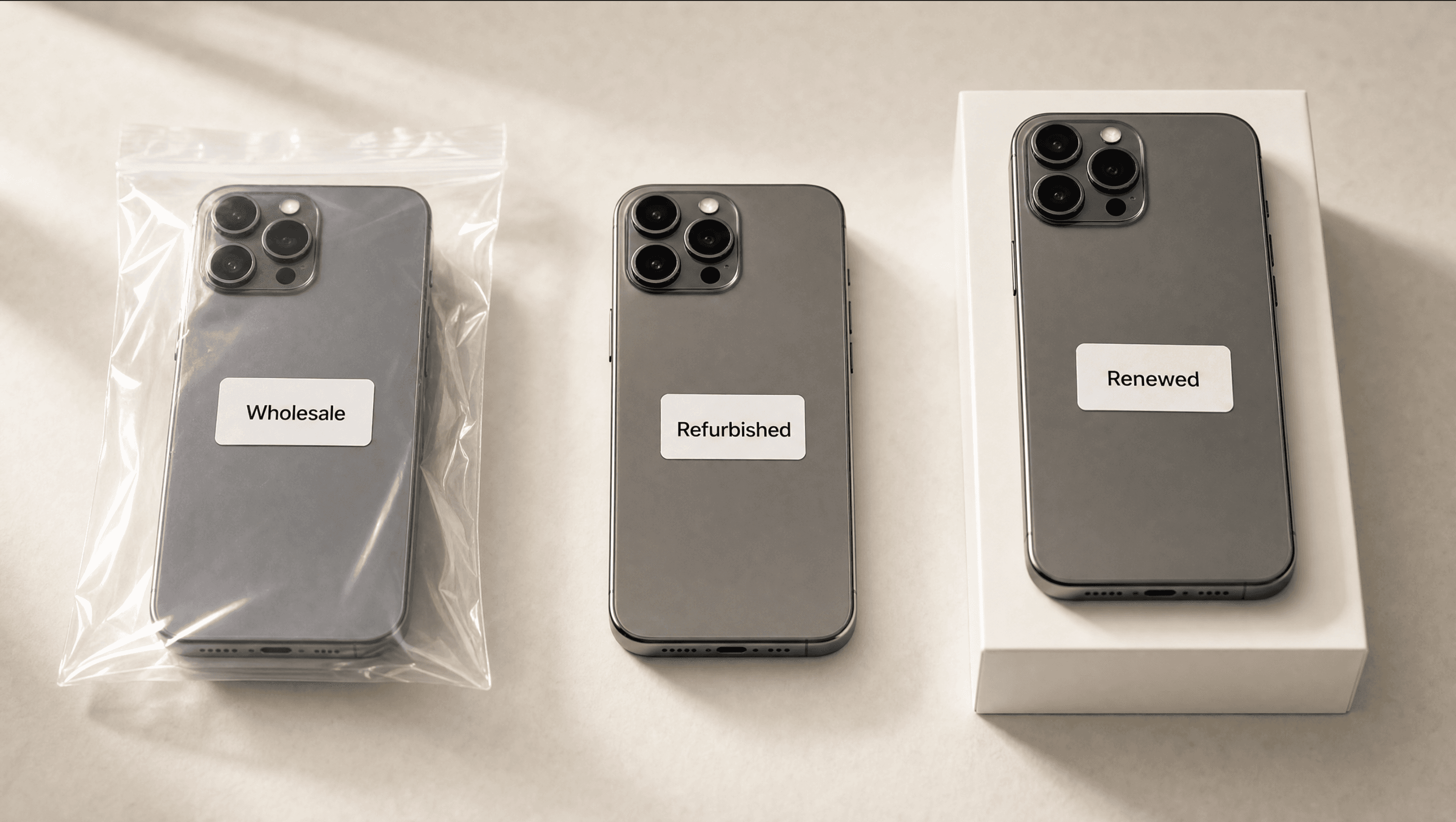
Buyers researching bulk smartphones run into the same three terms over and over: wholesale, refurbished, and renewed. The labels get used interchangeably in product listings, marketplace ads, and even by suppliers themselves, but they describe three distinctly different products, each priced differently, each suited to a different kind of business.
For someone placing a large order, the wrong term can mean the wrong product, the wrong margin, and the wrong customer fit. This guide explains what each term actually means, how the three categories overlap and differ, and which one is right for a given buyer.
The 30-second answer
Wholesale refers to bulk B2B inventory sold to businesses, typically resellers, repair shops, refurbishers, and exporters. Wholesale phones are graded by the supplier and sold as-is, with condition varying widely from brand-new sealed units to customer returns and trade-ins.
Refurbished phones are devices that have been professionally restored to working condition. The process usually includes a battery check and replacement where needed, screen repair if necessary, cosmetic cleaning, and a full functionality test. Refurbished phones are sold individually to consumers and come with a warranty.
Renewed is largely a marketing term, most often associated with Amazon Renewed and similar programs. The standards vary by seller, but in practice "renewed" usually means a lighter restoration than full refurbishment: inspection, testing, sometimes cosmetic cleaning, but not always battery or part replacement.
The three are not interchangeable. A wholesale buyer ordering "refurbished" phones is shopping in the wrong category. A consumer looking at "wholesale" inventory is looking at the wrong type of product. The differences matter.
What "wholesale" actually means
Wholesale phones are sold in bulk to businesses. The category covers a wide range of conditions, from brand-new sealed units pulled from a retailer's surplus inventory, to lightly-used trade-ins, to customer returns, to non-functional devices destined for parts harvesting. What unifies the category is the channel: wholesale inventory is sold business-to-business at bulk pricing tiers, not directly to end consumers through retail channels.
Because the condition varies so widely, wholesale suppliers use grading systems to communicate what a buyer is actually getting. The most common scale is A/B/C/D, where:
- Grade A units are in near-new cosmetic condition with full functionality
- Grade B units show light wear but function normally
- Grade C units have visible cosmetic damage but still work
- Grade D units are non-functional or partially functional and are typically sold for parts
The grading scale only means something if the supplier applies it consistently. Two suppliers can both advertise "Grade B" inventory and ship visibly different products. This is one of the most common surprises new wholesale buyers run into, and one of the most important things to verify before committing to a large order.
Wholesale pricing reflects bulk volume and the work the buyer is taking on: restoration, individual resale, returns, customer support. Per-unit cost runs meaningfully below retail for the equivalent condition, with the exact discount varying by model age, grade, and quantity.
Who buys wholesale? Resellers who list phones individually on eBay, Swappa, Facebook Marketplace, and similar platforms. Repair shops that need devices for parts. Refurbishers who restore wholesale stock and then resell it as refurbished. International exporters who ship North American inventory to markets where demand outstrips local supply. Each of these business types makes their margin on the spread between wholesale cost and the price they can fetch downstream.
What "refurbished" actually means
Refurbishment is the process of restoring a used device to working condition before resale. The work involved depends on the unit's starting condition, but a full refurbishment typically includes a battery health check and replacement where needed, a screen replacement if cracked or significantly degraded, replacement of any failing internal components, cosmetic cleaning, a fresh operating system install, and a complete functionality test.
Refurbished phones are sold individually to consumers, priced below a new equivalent. The discount is smaller than wholesale because the seller has already absorbed the labor, parts, and warranty costs.
There are two important sub-categories worth distinguishing. Manufacturer-refurbished devices, such as Apple Certified Refurbished, are restored by the original manufacturer to original-spec standards and come with the manufacturer's warranty. Third-party refurbished devices are restored by independent companies. The quality varies significantly between operators, and warranty terms vary as well.
For wholesale buyers, refurbished is less a competing product than a downstream destination. Many businesses that buy wholesale phones do their own refurbishment work and then sell the result as refurbished. Grade B and Grade C wholesale stock is particularly suited to this. The buyer absorbs the cost of restoration but captures the price premium that refurbished phones command on consumer marketplaces.
What "renewed" actually means
"Renewed" is primarily a marketing term, most strongly associated with Amazon's Amazon Renewed program. Amazon Renewed devices are inspected and tested by Amazon-approved sellers and sold with a 90-day Amazon Renewed Guarantee. Standards vary by seller within the program; the label communicates the existence of a guarantee more than a specific restoration process.
Outside of Amazon's program, "renewed" gets used loosely by various sellers to describe lightly-restored devices. In practice, "renewed" usually implies less work was done than full refurbishment: testing and inspection, often cosmetic cleaning, but not always battery replacement, screen replacement, or other parts replacement.
Apple's restored-device program is labeled Apple Certified Refurbished. The two terms sometimes get confused in marketing copy, but Apple's product is closer to a true refurbishment than what most "renewed" listings offer.
For business buyers, the practical implication of "renewed" is that the label alone says less about the product than "refurbished" does. When evaluating renewed inventory, the right question is what specific work was actually performed, not just what the label says.
Side-by-side comparison
| Wholesale | Refurbished | Renewed | |
|---|---|---|---|
| Sold to | Businesses (bulk) | Consumers (individually) | Consumers (individually) |
| Typical order size | Small pilot up to large bulk | Single unit | Single unit |
| Restoration done | None by supplier (graded as-is) | Full restoration (parts, battery, screen) | Light restoration (often cosmetic and testing only) |
| Warranty | None on the units; functional return window typical | 30 to 90 days, sometimes a year | Varies (Amazon Renewed offers a 90-day guarantee) |
| Best for | Resellers, repair shops, exporters, refurbishers | End consumers wanting a quality used device | Budget-conscious end consumers |
| Quality variance | High: grade-dependent and supplier-dependent | Low: warranty backs quality | Medium to high: seller-dependent |
The table makes a key point visible: wholesale is the only category that serves business buyers. Refurbished and renewed are both consumer products. If a business is buying in bulk to resell, repair, or refurbish, wholesale is the channel.
Which one is right for your business
The right category depends entirely on what the buyer plans to do with the inventory.
For resellers planning to list devices individually on eBay, Swappa, Facebook Marketplace, or similar platforms, wholesale is the answer. Grade A and Grade B inventory is commonly used for direct resale, since the cosmetic condition supports retail-style listings. The reseller's margin comes from the spread between bulk-buy pricing and individual-sale pricing.
For repair shops needing parts (screens, batteries, logic boards, cameras, charge ports), wholesale Grade C and Grade D stock is the right channel. These are devices with cosmetic damage or partial functionality, sold cheaply because they're not suited for direct resale. A shop can harvest valuable parts from a low-cost parts unit and keep them in stock indefinitely.
For businesses planning to refurbish and resell as refurbished, wholesale Grade B and Grade C stock is the typical input. The business buys at wholesale prices, does the refurbishment work, and resells at refurbished prices. The refurbishment work absorbs labor and parts cost, but captures the price premium that refurbished phones command on consumer marketplaces.
For international exporters serving markets where North American smartphone supply is constrained, wholesale is also the channel. Inventory is bought in bulk, shipped to the destination market, and resold either to local distributors or directly to consumers depending on the operator's setup.
For end consumers buying for personal use, neither wholesale nor most "renewed" listings are the right fit. Refurbished (ideally manufacturer-refurbished, like Apple Certified Refurbished) offers the best combination of quality assurance and warranty for a single-device purchase.
A note for buyers new to wholesale: starting with a small pilot order (often a couple dozen units, spread across a few grades) is a common way to test a supplier's grading consistency before scaling up. A pilot reveals more about supplier quality than any due-diligence checklist can.
How to evaluate a wholesale supplier
Wholesale phone sourcing has known scammer problems, and the consequences of choosing the wrong supplier can be severe. Wire transfer to a fraudulent supplier is typically not recoverable. A few signals separate legitimate operators from risky ones.
Transparent grading definitions. Legitimate suppliers publish their grading scale with specific criteria for each grade: what cosmetic standards correspond to Grade A versus Grade B, what functional standards apply, what testing process generates the grade. If a supplier can't show their grading rubric, the grades on their inventory don't mean much.
Standard payment methods. Wire transfer through major US banks is the most common payment method for large wholesale orders. Some suppliers also accept card payments through processors like Stripe, often with order size caps. Suppliers who insist on crypto-only payment, prepaid gift cards, or other irreversible payment methods that bypass dispute mechanisms are a serious red flag.
Real business identity. A US-based supplier should have a verifiable business address, an EIN, and a real presence, not just a free email address and a slick website. A quick check via state business registries or Googling the business name should turn up consistent results across multiple sources.
Written return policy. Legitimate suppliers put their return terms in writing, typically a short functional return window for defects, with cosmetic returns excluded since cosmetic condition is what the grading scale already communicates. A supplier who won't put the return policy in writing is a supplier who doesn't intend to honor it.
Reference checks. Established wholesale suppliers tend to have a reputation among other resellers and shops. Asking around in industry communities before committing to a large order is standard practice.
ICS Wireless publishes its A/B/C/D grading standards in full, accepts wire transfer and Stripe payment, operates from a verified business address in Bohemia, NY, and applies a written 7-day functional return policy to every order. These aren't competitive differentiators. They're the baseline for legitimacy in this industry.
Common questions
Are wholesale iPhones unlocked?
Both locked and unlocked inventory is sold wholesale. Locked phones are typically discounted relative to unlocked equivalents because they're tied to a specific carrier and have a smaller resale market. The wholesale supplier should clearly indicate the lock status on every variant. ICS Wireless inventory shows lock status as a filter on the catalog.
Do wholesale phones come with warranties?
Typically no warranty on the units themselves. The buyer is taking the condition as-graded. Most legitimate suppliers offer a short functional return window that covers defects: a phone that won't power on, has a non-functional component that the grade didn't disclose, or otherwise doesn't match what was sold. Cosmetic returns are usually excluded because cosmetic condition is communicated by the grade.
Can a wholesale phone be refurbished and resold as refurbished?
Yes. This is a common business model. A wholesale buyer purchases Grade B or Grade C stock at wholesale prices, performs the refurbishment work (battery, screen, parts as needed), and resells the restored devices as refurbished at the corresponding higher price point. The margin comes from the labor and parts the buyer adds to the original wholesale unit.
Why is wholesale cheaper than refurbished?
Wholesale pricing reflects the labor cost that hasn't been done yet. When a wholesale buyer takes a Grade B unit, they're absorbing the cosmetic risk, any necessary restoration work, and the cost of selling the device downstream. Refurbished pricing has already absorbed those costs and added them to the price.
How do shipping and import work for international wholesale orders?
For North American suppliers shipping internationally, the buyer typically pays international shipping per unit and is responsible for any import duties or VAT at the destination. Some suppliers operate transshipment hubs in regions like the UAE to consolidate fulfillment for buyers in Europe, the Middle East, and Africa. This reduces per-unit shipping costs and simplifies customs.
Closing
Wholesale, refurbished, and renewed describe three different products serving three different markets. Wholesale is the bulk B2B channel: graded as-is inventory sold to businesses that will resell, repair, refurbish, or export the devices. Refurbished is professionally restored stock sold with a warranty to end consumers. Renewed is a lighter-touch version of refurbished, more marketing label than standardized product.
For any business buyer ordering in bulk, wholesale is almost always the right category. The pricing reflects the bulk commitment and the work that hasn't been done yet, and the buyer's business model captures the value of that work when the phones move downstream.
ICS Wireless has been supplying wholesale Apple iPhones and Google Pixels to approved B2B buyers since 2017. The catalog shows live inventory, grading is published in full detail, and approved buyers see bulk pricing across all four grades.