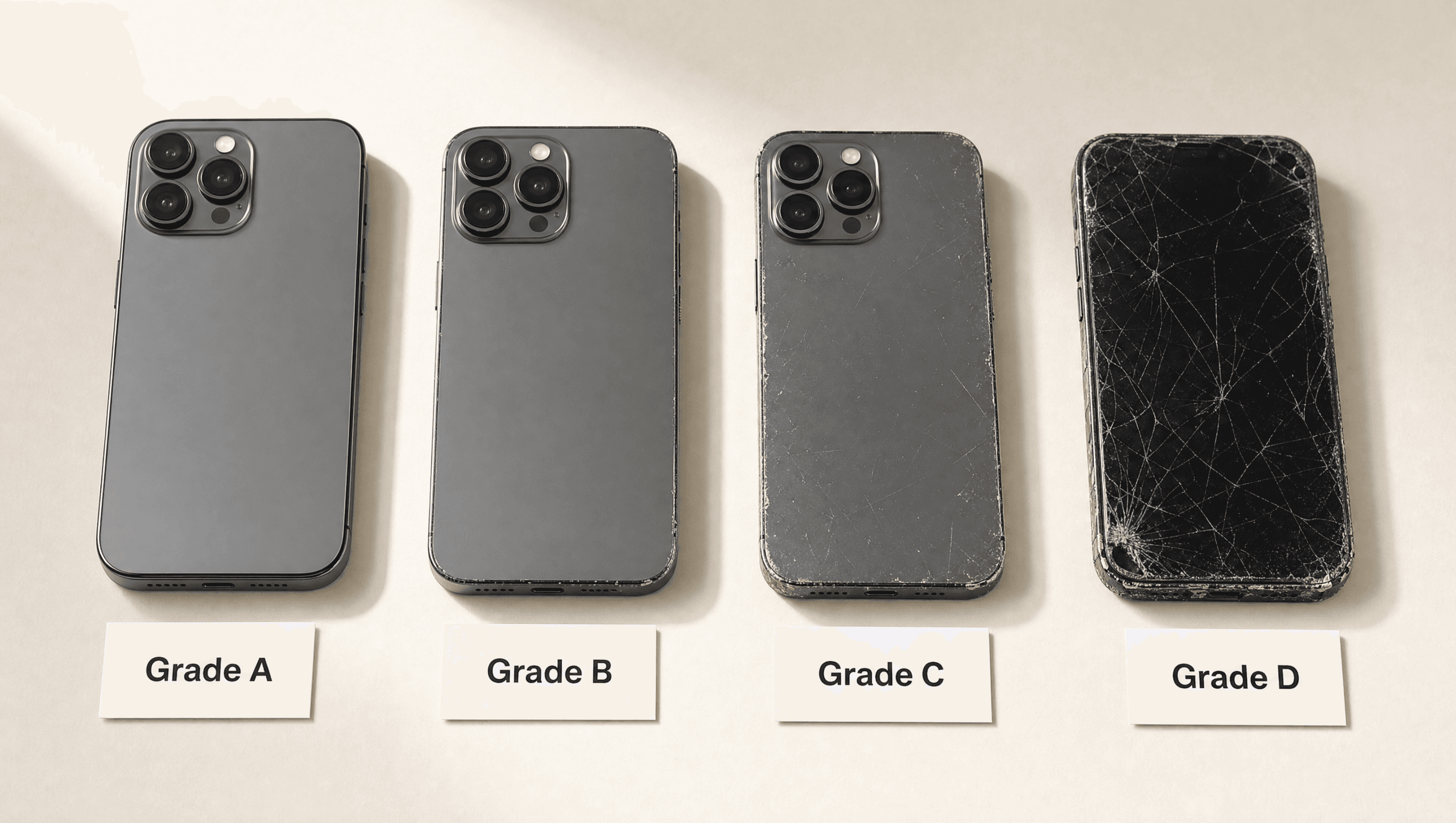
Two suppliers can both advertise "Grade B" iPhones and ship visibly different phones. The letter on the listing doesn't tell a buyer what they're getting. The supplier's interpretation of that letter does.
This is the most common surprise new wholesale buyers run into. They place a first order based on grade, the phones arrive, and the cosmetic condition doesn't match what they expected. The grading scale is real, and it's useful, but only when both the supplier and the buyer mean the same thing by "Grade B."
This guide explains the standard A/B/C/D wholesale grading scale, what each grade looks like in practice, how to evaluate any supplier's grading consistency, and what grading does and does not tell a buyer about the phones they're ordering.
Why grading exists in the first place
Wholesale phones come from many sources. Some are brand-new sealed units pulled from a retailer's surplus inventory. Others are lightly-used trade-ins from carrier programs. Others are customer returns. Others are devices traded in at the end of a lease. Others are units that failed in some way and got replaced under warranty.
Each unit has its own condition history. Pristine units sit next to lightly-scuffed units sit next to visibly damaged units in the same supplier's warehouse. A buyer placing a hundred-unit order needs a way to know what's in the box before it ships.
The grading scale is how the industry solves this. The supplier sorts incoming inventory into four buckets (A, B, C, and D) based on cosmetic condition and functional status. The buyer chooses which grade to order, and pays a price tied to the grade. Without a grading scale, every wholesale order would be a lottery. With it, the buyer has a reasonable expectation of what's coming.
The system works as long as the supplier applies the scale consistently and communicates the criteria openly. Where the system breaks down is when a supplier's "Grade B" is actually closer to what another supplier would call Grade C, or when the supplier never tells the buyer what their criteria are in the first place.
The A/B/C/D scale: what each grade means
Grade A
Grade A units are in near-new cosmetic condition. Up close and at arm's length, they look essentially indistinguishable from a new phone. Scratches are absent or only visible under specific angles of bright light. Edges and corners show no nicks. The screen is free of scratches or burn-in.
Functionally, Grade A units pass all standard checks. Battery health varies from unit to unit and is not certified unless the buyer orders it specifically. All sensors, cameras, speakers, microphones, and buttons work normally. Wi-Fi, Bluetooth, cellular, and Face ID or Touch ID all function. The device powers on, holds a charge, and performs without issue.
Grade A is the most expensive of the four grades but also the most flexible. It's commonly used for direct resale on consumer marketplaces like eBay and Swappa, where buyers expect a near-new appearance and pay accordingly. It's also used by businesses provisioning phones for employees, where appearance matters.
Grade B
Grade B units show light wear when examined closely. There may be small surface scratches on the back, light marks along the edges or corners, or very minor wear around frequently-used areas like the power button. The screen has no visible scratches or only the very faintest hairline marks not visible during normal use.
Functionally, Grade B is identical to Grade A. The phone works completely normally, and all components function as expected. As with every grade, battery health varies and is not certified unless ordered.
Grade B is often the best value tier for resellers. The phones look good in photos and to consumers, the per-unit cost is lower than Grade A, and the margin on resale tends to be the highest. Refurbishers also commonly start with Grade B stock. Light cosmetic touch-ups can move a Grade B unit closer to Grade A condition, capturing the price difference.
Grade C
Grade C units have visible cosmetic damage. Scratches on the back are obvious. There may be nicks on the edges or corners, light dents in the chassis, or noticeable wear marks. The screen may have light scratches, though it usually still works without issue. The phone clearly looks used.
Functionally, Grade C units still work. The phone powers on, holds a charge, and all core functions operate. Battery health varies and is not certified unless ordered, and some sensors may show minor degradation, but the device remains usable.
Grade C is the budget tier for resellers who plan to do cosmetic touch-ups before resale, for repair shops needing functional devices to keep on hand, or for buyers serving markets where price matters more than appearance. Grade C is also where refurbishers find the most margin opportunity. These units need real work, and the refurbishment process captures the value of that work.
Grade D
Grade D units, often described as "Parts & Repair," are sold for component harvesting rather than direct use. They include phones with cracked screens, dead batteries, water damage, non-functional cameras or speakers, charging issues, or other significant defects. Some are partially functional, some don't power on at all.
What makes Grade D valuable isn't the phone as a whole. It's the parts inside. A phone with a cracked screen still has a working logic board, undamaged cameras, working buttons, and other components that repair shops need. A repair shop can buy Grade D inventory cheaply and harvest parts to keep in stock for months of repair jobs.
Grade D is not suited for direct resale. Buyers purchasing Grade D should understand what they're getting: a low-cost source of parts, not a sellable phone.
What grading does NOT tell you
The grading scale communicates cosmetic and functional condition. It does not communicate several other things that wholesale buyers need to verify separately.
Carrier lock status. A phone can be Grade A and still be locked to a specific carrier. Locked phones have a smaller resale market and a lower price ceiling. The grade letter doesn't reveal lock status. The supplier needs to disclose it separately, and the buyer needs to check.
IMEI status. A phone can be in pristine cosmetic condition and still be blacklisted, meaning it was reported lost or stolen and can't be activated on most carriers. The grade letter doesn't reveal IMEI status. Buyers should run an IMEI check on a sample of any order to verify clean status.
iCloud lock or activation lock. A phone can pass every cosmetic and functional grading test and still be locked to its previous owner's Apple ID or Google account, making it useless until that account is removed. This is rare in legitimate supply chains but worth checking on any order.
Battery health specifics. Some suppliers include battery health thresholds in their grading scale (a minimum percentage for Grade A, etc.) and some don't. Buyers planning to resell consumer-direct may want to verify battery health on each unit at receipt, since consumers ask about it.
Warranty status. Wholesale phones rarely come with original manufacturer warranty. The grade letter doesn't communicate warranty coverage, and there usually isn't any from the manufacturer's perspective.
The grade is one input. The buyer's verification is the other.
How suppliers vary
The A/B/C/D scale is industry-standard in letters but not in application. Different suppliers apply the criteria differently, and the differences matter.
Some suppliers are strict: a small scratch that one supplier would call Grade A, another supplier would call Grade B. A small dent that one supplier accepts in Grade B, another moves to Grade C. The strictness usually reflects the supplier's source of inventory (carrier returns tend to be more uniform; estate buys and pawn-shop lots tend to be all over the map) and their internal quality control processes.
Some suppliers include functional testing in their grading process. They power on every unit, test every sensor, verify every button. Others only inspect cosmetic condition and trust that the source already tested functionality. The first approach yields more consistent Grade A/B/C, but takes longer and costs more per unit.
Some suppliers blend grades in a single shipment ("mixed A/B" or "B/C lot") to clear inventory. Buyers should know whether they're buying a single grade or a mix before placing the order.
The practical implication: the same letter from two suppliers can describe meaningfully different products. The grade isn't a universal standard; it's a supplier-specific signal that only means something once the buyer learns how that supplier applies it.
How to evaluate any supplier's grading
A buyer choosing between suppliers can't rely on the grade letter alone. The actual practice that separates reliable suppliers from unreliable ones is the criteria behind the letter.
Ask for written grading criteria. Legitimate suppliers publish their grading scale with specific criteria for each grade: what cosmetic standards correspond to Grade A versus Grade B, what functional tests are applied, what gets a unit moved to a different grade. If a supplier can't show their grading rubric, the grades on their inventory don't mean much. ICS Wireless publishes its A/B/C/D grading standards in full so buyers know what each grade includes.
Request recent photos. Suppliers should be able to share photos of recent stock at the grade the buyer is interested in. Not stock photos from a website, but actual photos of inventory currently for sale. This reveals whether the supplier's "Grade B" matches the buyer's expectation of Grade B.
Place a small pilot order across multiple grades. Before committing to a large order, ordering a small mixed batch (a handful of Grade A, Grade B, and Grade C units) reveals consistency directly. The phones arrive, and the buyer compares what was received to what was ordered. This single test reveals more about supplier quality than any written rubric.
Build a relationship rather than chasing price. Once a buyer has confirmed that a supplier's grading matches expectations, sticking with that supplier reduces uncertainty. Constantly switching suppliers in search of slightly lower per-unit cost reintroduces the grading-consistency problem with every new vendor. Reliable grading is worth paying slightly more for.
Common questions
Can a buyer return a phone if they disagree with its grade?
Most suppliers exclude cosmetic returns explicitly. That's what the grading scale is for. If the buyer received Grade B and thinks it looks more like Grade C, the supplier will typically point to the grading rubric and decline the return. Functional defects (a phone that won't power on, a non-working camera) are usually accepted under the supplier's short return window.
Why are Grade D phones still not cheap?
Because their parts are valuable. A working logic board, undamaged camera modules, working buttons, charge ports: each of these has real resale value on the parts market. Repair shops can recoup the cost of a Grade D unit by selling or using two or three of its components. Grade D pricing reflects the underlying parts value, not the phone-as-a-whole value.
Are there grades below D?
Some suppliers use additional designations (E or F or "salvage") for units that don't even meet Grade D parts standards. Most stop at D = parts. If a supplier offers something below D, the buyer should ask specifically what's wrong with the units and whether they're sold for parts harvesting at significantly lower prices.
Do new sealed phones get graded?
No. New sealed phones (units still in their original retail packaging, never opened or activated) are sold as new sealed, separate from the used-phone grading scale. Grades A through D apply only to phones that have been opened and used at some point.
Does grading work the same for Google Pixel and other Android phones?
Yes. The A/B/C/D scale applies to any wholesale smartphone: iPhones, Pixels, Samsung Galaxies, and others. The cosmetic and functional standards are essentially the same. The grading principles are universal even though the specific cosmetic concerns vary slightly between phone designs.
Closing
Wholesale phone grading exists to communicate condition between supplier and buyer. The standard letter scale (A, B, C, D) gives both parties a shared vocabulary. But the letter alone isn't enough. The supplier's interpretation matters. The supplier's consistency matters more.
For buyers choosing between suppliers, the most important signal is whether the supplier publishes written grading criteria and applies them consistently order after order. A small pilot order reveals more about a supplier than any sales pitch.
ICS Wireless publishes its A/B/C/D grading standards in full and applies them consistently across every order. The catalog shows live inventory at each grade, and the Wholesale vs Refurbished vs Renewed guide covers how grading fits into the broader wholesale market.