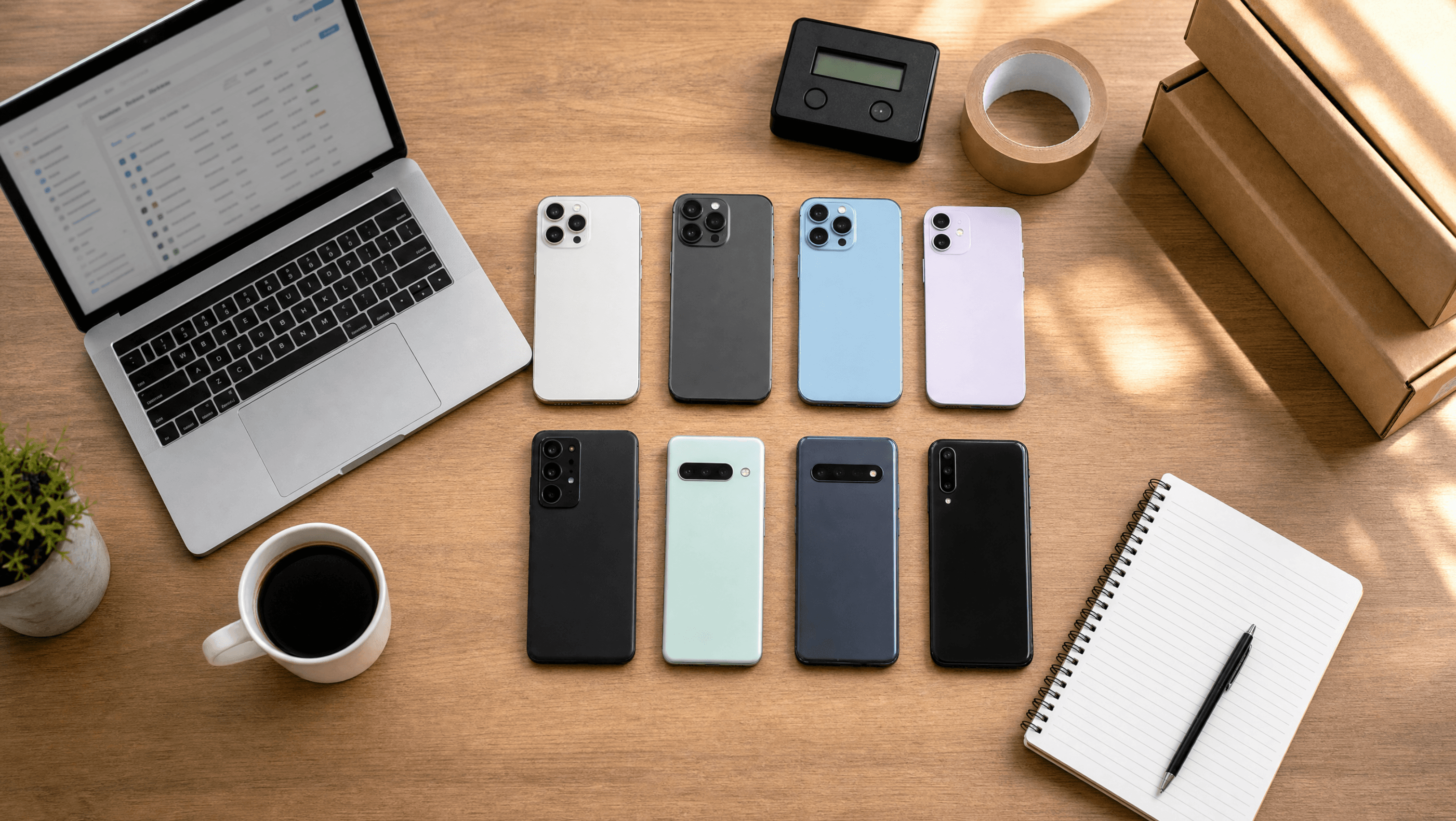
Phone reselling is a real business with real margins, but it's not the "easy passive income" some YouTube videos make it look like. Every phone is work: inspection, photos, listing, packing, shipping, customer service, returns. For someone willing to treat it as a business, the market still has room. For someone expecting passive income, it's the wrong fit.
This guide covers the full picture: business model options, what you actually need to start, how to source inventory, sales channel comparison, common mistakes, and realistic margin expectations. Written for someone seriously considering entering the market, not someone looking for hype.
The four main reseller business models
Before placing a first order, the most important decision is which model to pursue. Each has different capital requirements, skill needs, and margin profiles. Picking the wrong one wastes time and money.
Direct resale
Direct resale means buying wholesale Grade A or Grade B inventory and listing it individually on consumer marketplaces: eBay, Swappa, Facebook Marketplace, Mercari, or a dedicated Shopify store. The phones don't need refurbishment; the work is inspection, photographing, listing, customer service, and shipping.
Margin per phone is modest but volume scales. The capital requirement is lower than other models because there's no parts inventory or repair tooling. This is the most common starting point for new resellers, especially side-hustlers building gradually.
Buy and refurbish
This model takes Grade B or Grade C inventory and restores it before resale. The work includes battery replacement when health is low, screen replacement if cracked, replacement of any failing components, deep cosmetic cleaning, and OS-level reset. The phones are then sold as refurbished, either through consumer marketplaces or through a dedicated refurbisher channel.
Margins are higher per phone because refurbished commands a higher price than direct-resold used. The catch is the skill requirement: refurbishment work requires real repair experience, parts inventory, soldering tools, screen replacement experience, and time per phone. The reseller is also effectively a small repair shop.
Parts harvesting
Parts harvesting buys Grade D inventory (phones that don't work as a whole) and salvages working components. Screens, batteries, logic boards, cameras, buttons, charge ports, and other internal parts get pulled and sold individually to repair shops or used in the reseller's own repair work.
This model is niche and high-margin if there's existing demand. Most parts harvesters serve a network of local repair shops they already know. Starting cold without that network is harder. The parts have value but only if someone is buying.
Export reselling
Export reselling buys wholesale phones in the US and ships them to international markets where consumer-market phone prices are higher. Common destinations include Latin America, sub-Saharan Africa, and parts of Southeast Asia, where US iPhones in particular sell at premiums significantly above US market prices.
Margins can be excellent, but the operational complexity is real. The exporter handles international shipping, customs documentation, import duties or VAT at the destination, currency exchange, payment from buyers in different financial systems, and the regulatory landscape of multiple countries. New exporters typically partner with an established local distributor at the destination rather than selling directly to consumers.
What you actually need to start
The capital, time, and infrastructure requirements vary by model, but a few things apply across all four.
Capital. Starting capital varies widely depending on the business model and how aggressively the operator wants to grow. Too little capital means a buyer can't place an order large enough to test a supplier's grading or to absorb the cost of the inevitable defective unit. Too much capital at the start risks committing to a model or supplier before learning whether either is the right fit. New resellers should budget enough to make a meaningful first order with a supplier they've vetted, plus reserve capital to handle defects, returns, and the gap between paying for inventory and selling it.
Business setup. Forming an LLC or similar business entity separates personal and business finances and limits personal liability. An EIN is needed for opening a business bank account and for tax filings. Sales tax registration is required in most US states for retailers. Phones are taxable in most jurisdictions, and online marketplace sales typically require sales tax collection. This area benefits from a one-hour consultation with a local accountant or attorney; the rules differ by state and by sales channel.
Workspace. A clean, organized space for inspecting, photographing, testing, and shipping phones. Doesn't need to be much: a desk, a clean backdrop, good lighting for photos, and storage for inventory and shipping supplies. Phones get damaged by sloppy workspaces, so cleanliness and organization aren't optional.
Tools. An IMEI verification service (some are free, some are subscription-based), battery health testing tools, basic functional testing (knowing what to check on each unit), shipping supplies (boxes, padded mailers, bubble wrap, packing tape), a label printer for shipping, and basic photography setup. Refurbishers also need repair tools: screwdrivers, suction cups, heat guns, screen replacement parts inventory.
Sales channel accounts. Marketplace seller accounts on whichever platforms the business plans to use. Most require an established account with feedback before unlocking higher selling limits, so new resellers may face listing limits in the first few months.
Sourcing inventory: how to find a wholesale supplier
The single most important decision in this business is which supplier to buy from. A reliable supplier with consistent grading makes everything else easier. An unreliable supplier with inconsistent grading turns every order into a problem.
Where to look. B2B directories like ThomasNet and Kompass list verified wholesale phone suppliers. Industry trade shows (wireless retailer conventions, mobile expos) bring suppliers and buyers together in person. Reseller community forums on Reddit, Discord, and Facebook often discuss which suppliers are working well and which to avoid. Referrals from other resellers are the most reliable signal but require existing industry relationships.
Red flags. Suppliers who insist on crypto-only payment, refuse to put their grading rubric or return policy in writing, demand large minimum first orders, can't provide a verifiable business address or EIN, or won't share recent stock photos are all warnings worth heeding. Wire transfer to a fraudulent supplier is typically not recoverable. A few hours of due diligence prevents months of financial pain.
How to vet. State business registries reveal whether a US supplier is actually registered. Googling the business name should turn up multiple consistent results: website, social media, news mentions, customer reviews. Asking the supplier for two or three customer references and actually calling those references reveals more than any sales pitch.
The pilot-order test. Before committing to a large order, place a small pilot order across multiple grades. The phones arrive, and the buyer compares received condition to ordered grade. This single test reveals supplier consistency, packaging quality, shipping speed, and what happens when something goes wrong. The pilot may not be profitable on its own, but the information it provides is worth more than the cost.
The wholesale vs refurbished vs renewed guide covers what wholesale actually means and how it differs from other sources. The grading guide covers what to expect at each grade level.
How to grade and price your inventory
Once stock arrives, the reseller's work begins. Each phone needs to be inspected against the supplier's grade promise, photographed clearly, and listed at a competitive price.
Inspection means powering on every unit, verifying that all sensors and components work, checking battery health, running IMEI on a sample to confirm clean status, and examining cosmetic condition against the grade. Phones that don't match their grade get reported to the supplier under the return window. Phones that exceed their grade are bonuses. A Grade B that's effectively Grade A can be priced as Grade A.
Pricing requires market research. eBay's completed listings show what each model in similar condition is actually selling for, not just what sellers are asking. Swappa's market price is also a useful benchmark. Pricing too low erodes margin without speeding up sales. Pricing too high leaves inventory sitting. The right price is just below the median for similar listings, with enough margin built in to cover marketplace fees, shipping, and the inevitable returns.
Strong photos matter more than most new resellers realize. Clear lighting, multiple angles, accurate representation of condition including any visible scratches or marks. Hiding condition in photos creates returns and bad reviews. Showing condition honestly creates trust.
Sales channels compared
Different marketplaces serve different audiences and have different cost structures.
eBay is the largest marketplace with the broadest audience. High volume potential, but also high competition and significant fees (10-13% per sale plus payment processing). Strong buyer protection means returns are common; sellers need to expect them.
Swappa specializes in phones and tablets. Smaller audience than eBay but higher buyer intent, since people on Swappa are specifically shopping for phones. Lower fees (around 3% for buyers, no seller fees). Stricter listing requirements including mandatory IMEI verification.
Facebook Marketplace has zero fees and large local audiences. Best for local pickup sales, where the buyer inspects in person. Limited buyer protection means dispute resolution falls on the seller.
Mercari is mid-tier in audience size. Fees comparable to eBay. Good for smaller, lower-priced units.
Own Shopify store offers the highest margins (no marketplace fees beyond payment processing) but requires the reseller to generate their own traffic. Works once the reseller has built a customer base; doesn't work for new resellers without marketing budget.
Most resellers start on eBay or Swappa, expand to Facebook Marketplace for local sales, and consider their own store only after building reputation elsewhere.
Realistic margins and what to expect
Margins vary significantly by business model.
Direct resale margins tend to be modest per phone, typically in the range that covers marketplace fees, shipping, the cost of returns, and leaves a slim profit. Volume is what makes this model work. A reseller moving 100 units a month at modest per-unit margin can still earn meaningfully, but at 10 units a month the business may not justify the time.
Refurbishment margins are higher per phone but require time and skill. A refurbisher who can complete a unit in two hours of work (battery replacement, screen check, cleaning, testing, photography, listing) captures real value. A refurbisher who takes six hours per phone is effectively earning very little per hour.
Parts harvesting margins depend entirely on existing repair shop relationships. With buyers lined up, margins are excellent. Without buyers, the inventory sits.
Export reselling margins are typically the highest but the operational overhead and capital tied up in shipping is also the highest.
Most new resellers underestimate the time per phone in the first year: inspection, photos, listing, customer service, shipping, returns. Effective hourly wage in the first year is often modest while building reputation, processes, and supplier relationships. By the second year, with established processes and a tested supplier, the math improves significantly.
Common mistakes new resellers make
A short list of pitfalls that derail new operators:
Buying too much inventory before testing the supplier. Excitement leads to large first orders. The grading inconsistency only becomes visible after the order arrives. By then the capital is committed.
Underpricing to compete on price. Racing to the bottom of the market erodes margin without speeding sales meaningfully. Slightly-below-median pricing with clear photos beats lowest-price-in-the-market.
Skipping the IMEI check. Blacklisted phones are useless. A few minutes of IMEI verification per unit prevents the problem.
Ignoring sales tax until it becomes a problem. Marketplace sales tax collection rules are complex but unambiguous. Ignoring them leads to back taxes and penalties.
Not photographing devices well. Photos drive conversion on every marketplace. Sloppy photos lose sales to competitors with sharper photos and equivalent inventory.
Mixing personal and business funds. Bookkeeping nightmare at tax time. Separate accounts from day one.
Ignoring returns culture. eBay and Swappa both expect that some percentage of sales will be returned. Sellers who treat returns as failures rather than as a cost of doing business burn out fast.
Scaling from side hustle to real business
The transition from "selling a few phones on the side" to "running a real reselling business" happens around 30-50 units per month. At that volume, the operator's time becomes the bottleneck, and several things change:
- Inventory financing becomes relevant. Operating with a line of credit instead of personal funds extends purchase capacity
- A dedicated workspace replaces the kitchen table: better photography, faster turnaround, less family friction
- Hiring help (typically a part-time person for photos, listings, and packing) frees the owner to focus on supplier relationships and pricing
- Building a primary supplier relationship (first look at new inventory, negotiated pricing, occasional credit terms) separates established resellers from newcomers
- Expanding sales channels: adding a second or third marketplace, considering an own-store presence
These transitions happen gradually. The reseller who builds them deliberately ends up with a stable business. The reseller who scales too fast (too much inventory, too many channels, too much hiring before processes are stable) often retreats back to a smaller operation.
Closing
Phone reselling in 2026 is a real business. The market has room for new entrants who treat it operationally. Margins are real. Supplier relationships matter more than almost any other variable. Patience in the first year (testing suppliers, building processes, learning the marketplace economics) pays off in years two and three when the business stabilizes.
For new resellers researching where to source inventory, the wholesale vs refurbished vs renewed guide explains the channels available. The grading guide covers what to expect from each A/B/C/D tier of wholesale inventory.
ICS Wireless supplies wholesale Apple iPhones and Google Pixels to approved B2B buyers across the US and internationally. The catalog shows live inventory and the grading page covers the standards we apply.